
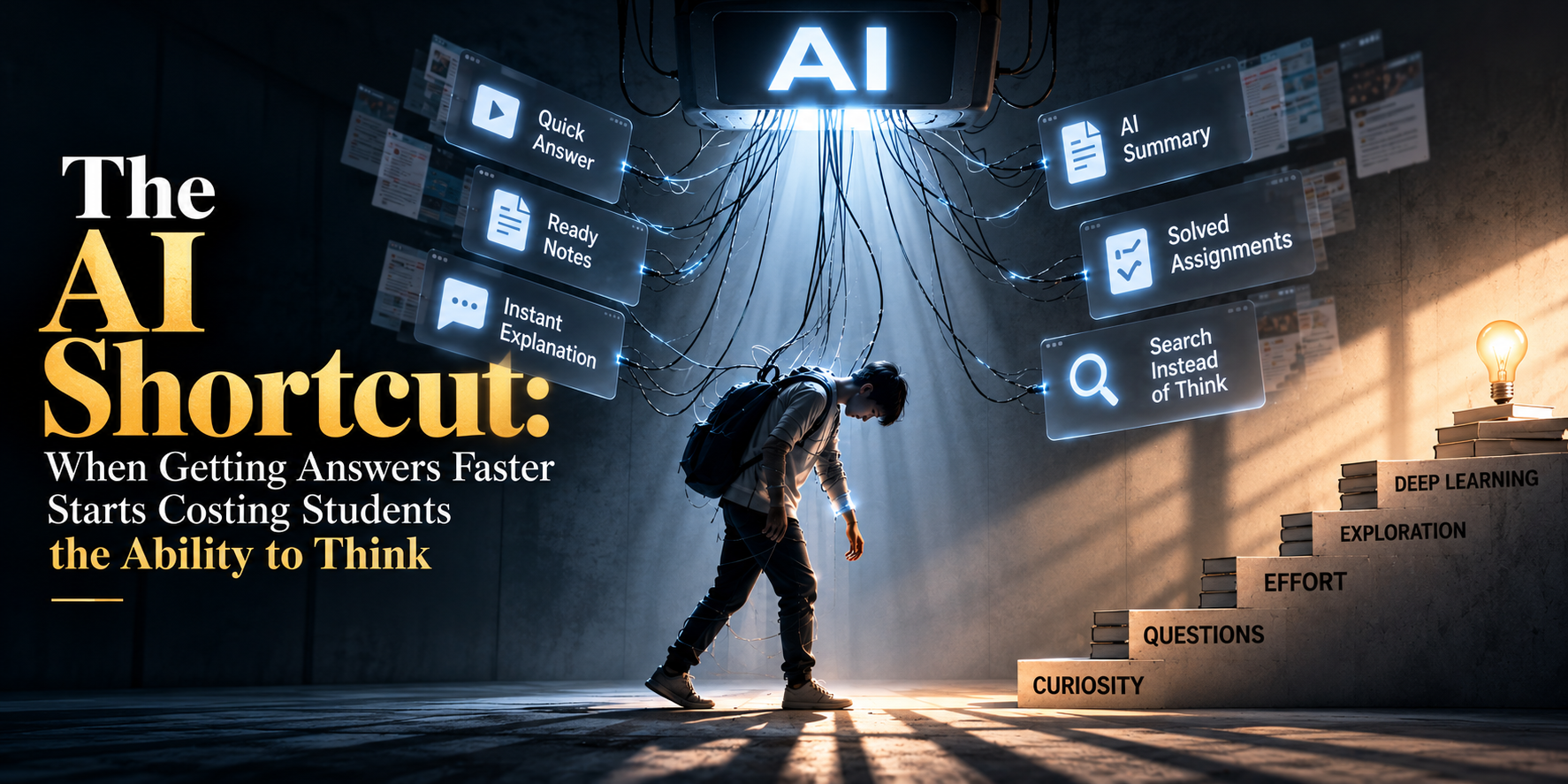
A student has a difficult question.
There are two possible reactions.
The first is to stop, think, recall what has been learned, attempt an answer, make mistakes, reconsider the problem and try again.
The second is considerably faster.
Open an AI tool. Type the question. Read the answer.
In seconds, something that might have taken twenty minutes of mental effort can appear neatly explained.
From the perspective of speed, the second approach looks intelligent.
From the perspective of education, however, a more difficult question appears:
If the student gets the answer without doing the thinking, what exactly has the student learned?
This is not an argument that students should stop using artificial intelligence.
That would be both unrealistic and intellectually unhelpful.
AI can explain difficult concepts, generate examples, provide feedback, challenge assumptions, create practice questions and help students explore subjects from different perspectives. UNESCO's student AI competency framework similarly places emphasis on students developing the ability to understand, apply and create with AI while maintaining critical judgement and human agency. 2
The real issue is more subtle.
What happens when convenience becomes a substitute for cognition?
The Difference Between Getting an Answer and Learning
Education has never been simply about collecting answers.
A student who memorises the solution to one mathematics problem may be able to reproduce it. That does not necessarily mean the student can recognise the same principle when the numbers change.
A student who copies a well-written explanation may submit an excellent assignment. That does not necessarily mean the student can explain the argument independently the following week.
A student who asks AI to summarise an entire chapter may know what the summary says. That does not necessarily mean the student has developed the ability to identify what matters inside a long and complicated text.
The distinction is between performance and learning.
Performance asks:
“Can I produce the required result?”
Learning asks:
“Can I understand, reproduce, adapt, question and apply what I have learned?”
A 2025 commentary in Nature Reviews Psychology highlighted precisely this distinction, noting that GenAI can improve learners' performance without necessarily producing the deep cognitive and metacognitive processing associated with high-quality learning. 3
The AI Shortcut
Every technology removes some form of human effort.
A calculator removes some arithmetic effort.
A search engine removes much of the effort involved in locating information.
Spell-checking software removes part of the effort involved in detecting spelling errors.
AI can now remove effort from much more complicated activities: writing, summarising, explaining, brainstorming, coding, translating, analysing and even solving problems.
That creates an important educational distinction.
Some effort is unnecessary friction. Some effort is the learning itself.
If a calculator performs arithmetic that a student has already learned, little educational value may be lost.
But if a student has not yet developed mathematical reasoning and immediately delegates the reasoning to a machine, the removed effort may have been precisely the activity through which that ability was supposed to develop.
This is where the AI shortcut becomes complicated.
The Thinking Gap
Consider a concept we can call the Thinking Gap.
The Thinking Gap is the distance between receiving an answer and being able to construct and defend the answer independently.
A student may receive an excellent explanation from AI in ten seconds.
But understanding that explanation may require:
- prior knowledge,
- attention,
- comparison,
- questioning,
- memory,
- reasoning,
- application, and
- reflection.
The answer can arrive instantly.
The understanding cannot necessarily be downloaded at the same speed.
That is the Thinking Gap.
When the Brain Becomes a Passenger
The greatest concern is not that students will use AI.
The greater concern is that students may gradually stop practising the mental activities that education is supposed to strengthen.
Imagine a student who uses AI every time a question becomes difficult.
The student does not attempt the mathematics problem.
The student does not struggle to organise the essay.
The student does not try to remember the biological process.
The student does not formulate an argument before asking for one.
The student does not identify weaknesses in the first draft.
Each individual decision seems harmless.
But over time, a pattern develops:
Difficulty → AI → Answer.
The student becomes increasingly efficient at obtaining outcomes without necessarily becoming equally capable of producing the reasoning behind them.
The brain has not stopped functioning.
It has simply been given fewer opportunities to practise certain functions.
But Cognitive Offloading Is Not Automatically Bad
This is where the conversation needs nuance.
Humans have always used tools to reduce cognitive load.
We write notes because we cannot remember everything.
We use calendars because we do not want to remember every appointment.
We use calculators because mental arithmetic is not always the best use of attention.
We use search engines because storing every piece of factual information in memory is impossible.
This is known as cognitive offloading: transferring some mental work to an external system.
Research does not support the simplistic conclusion that all AI-assisted cognitive offloading is harmful. A 2025 study of preservice teachers, for example, found positive associations between generative-AI use, cognitive offloading, metacognitive processes and academic achievement within its study context. 4
The more important question is therefore not:
“Did AI do some of the work?”
It is:
“Which part of the work did AI do—and which part did the student still need to understand?”
The Calculator Comparison Is More Complicated Than It Looks
People often say:
“Students using AI is just like students using calculators.”
There is some truth in the comparison.
Both tools can remove routine work and allow attention to move toward higher-level tasks.
But there is an important difference.
A calculator generally performs a defined mathematical operation.
Generative AI can participate in much broader cognitive activities.
It can formulate an argument, select examples, rewrite a paragraph, explain a concept, generate a solution and produce a polished final response.
That means the boundary between tool assistance and substitution for the learner's own work can become much harder to see.
The educational question therefore becomes more important:
Which intellectual tasks must remain the student's responsibility?
The Most Dangerous Shortcut Is Not the Obvious One
Copying an entire AI-generated assignment is obviously a shortcut.
But there is a more subtle form.
A student may ask AI:
“Explain this topic simply.”
The explanation may be excellent.
Then the student reads it once and moves on.
There is no attempt to explain it independently.
No example is created.
No question is answered without assistance.
No connection is made with previous knowledge.
The student experienced information.
But experiencing information is not necessarily learning.
Productive Struggle Has a Purpose
Students often describe difficult learning as frustrating.
And sometimes it is.
But not all difficulty is a defect in the learning process.
Trying to remember something and failing can reveal a knowledge gap.
Attempting a problem incorrectly can expose a misunderstanding.
Writing a weak paragraph can reveal that the writer has not yet understood the argument.
Struggling to explain an idea can reveal that the idea is not yet fully understood.
These moments provide information.
They tell the learner:
“This is where your understanding needs work.”
If AI immediately removes every difficult moment, the student may also lose some of the feedback that those moments provide.
The Difference Between Help and Substitution
Consider two students studying the same subject.
Student A:
“Give me the answer.”
AI gives the answer.
Student B:
“I think the answer is X because of A and B. Tell me where my reasoning is weak.”
AI challenges the reasoning.
Student B now has something to evaluate.
The AI is not simply producing an outcome.
It is participating in a learning process.
This difference is fundamental.
AI can be an answer machine, or it can become a thinking partner.
The student's behaviour determines which one it becomes.
AI Should Challenge Students, Not Just Satisfy Them
A powerful educational use of AI is not necessarily asking it to provide the best answer.
It may be asking it to challenge the student's answer.
For example:
- “Here is my reasoning. Find the weakest assumption.”
- “Ask me questions until I can explain this concept.”
- “Give me a similar problem without the solution.”
- “Challenge my argument from the opposite perspective.”
- “Tell me what I have misunderstood, but do not give me the answer yet.”
These approaches preserve the student's role as the thinker.
UNESCO's guidance similarly discusses using GenAI in ways that trigger higher-order thinking, including inquiry and Socratic-style dialogue, while stressing that students need enough prior knowledge to evaluate AI-generated information. 5
The New Definition of “Smart”
For years, students were rewarded for knowing answers.
In an AI-rich environment, that definition becomes less sufficient.
If a machine can produce an answer instantly, the valuable human capability shifts toward:
- asking the right question,
- recognising a weak answer,
- checking evidence,
- identifying assumptions,
- connecting ideas,
- making judgements,
- explaining reasoning, and
- knowing when the machine is wrong.
UNESCO's AI competency framework explicitly places critical judgement, ethics and human-centred thinking among the capabilities students need in the AI era. 6
In other words, AI may reduce the value of simply having an answer.
It may increase the value of knowing what to do with an answer.
The Student Who Never Learns to Question
There is another risk.
AI can produce answers that sound convincing.
That does not make every answer correct.
Generative AI systems can produce inaccurate information, incomplete reasoning or misleading confidence. UNESCO has specifically identified reliability, bias and hallucinated information among the risks of using generative AI in education. 7
A student who has developed subject knowledge can question an AI response.
A student who has outsourced the learning process may not know that the answer deserves questioning.
This creates an unusual paradox:
The less you know, the harder it may be to recognise when AI is wrong.
That is why foundational knowledge does not become obsolete simply because AI exists.
It becomes part of the student's defence against incorrect AI output.
The Search for Speed Can Become a Search for Certainty
Students do not always use AI because they are lazy.
Sometimes they are under pressure.
Examinations are approaching.
An assignment is due tomorrow.
A concept feels confusing.
There are several chapters to complete.
AI offers something extremely attractive:
certainty, immediately.
Instead of sitting with uncertainty, the student can receive a polished explanation.
But uncertainty has an educational function.
It creates the need to investigate.
It creates questions.
It exposes gaps.
It forces the learner to distinguish what is known from what is assumed.
If every uncomfortable gap is immediately filled by AI, students may become better at completing tasks while becoming less comfortable with the process of figuring things out.
The Five-Second Rule
Before asking AI to solve a difficult academic problem, a student can adopt one simple habit:
Try first. Ask second.
Spend a few minutes attempting the problem.
Write down what is known.
Identify what is confusing.
Make a prediction.
Then use AI.
This changes the role of the technology.
Instead of replacing the first attempt, AI becomes a second layer of assistance.
A Better AI Learning Cycle
A healthier learning cycle could look like this:
Question → Attempt → AI Feedback → Correction → Explanation → Independent Retest
The final step matters.
After receiving help, the student should close the AI tool and attempt the problem again.
If the student can now solve it independently, the technology has contributed to learning.
If the student can only reproduce the AI's answer while the AI remains present, the learning may not yet be secure.
The Real Test: Can You Do It Without AI?
There is a simple test for almost every academic use of AI.
After using AI, ask:
“If the AI disappeared right now, could I still explain or solve this?”
If the answer is yes, AI probably assisted the learning process.
If the answer is no, the student may have acquired an answer without acquiring enough understanding.
This is not a perfect scientific measurement.
It is a useful discipline.
What Students Should Stop Asking AI to Do
There are certain tasks where students should be particularly careful about outsourcing the entire process:
- Writing the final answer before attempting the assignment.
- Solving a problem without first understanding what is being asked.
- Summarising material that has never been read.
- Generating arguments that the student cannot independently explain.
- Writing reflections about experiences the student has not personally analysed.
- Producing exam answers that the student has never practised independently.
The issue is not whether AI technically can perform these tasks.
It obviously can.
The issue is whether performing them removes the very practice through which the student's ability develops.
What Students Should Use AI For
Used thoughtfully, AI can become extremely valuable.
Students can use it to:
- explain a difficult concept in multiple ways,
- generate additional practice questions,
- act as a debate partner,
- identify weaknesses in their reasoning,
- compare competing explanations,
- create revision exercises,
- simulate interviews or oral examinations,
- receive feedback on drafts, and
- identify areas they need to study further.
In each case, the student remains intellectually involved.
The Teacher's Role Is Changing Too
This issue cannot be placed entirely on students.
Education systems also have to adapt.
If an assignment can be completed perfectly by asking an AI system one question, the problem may not simply be that students have discovered the shortcut.
The assessment itself may need reconsideration.
Teachers can increasingly ask students to:
- show their reasoning,
- defend their conclusions orally,
- reflect on mistakes,
- compare alternative answers,
- critique AI-generated material,
- apply concepts to unfamiliar situations, and
- document how their thinking changed during the task.
This moves assessment away from merely measuring the final product and toward measuring the student's intellectual process.
The Future Student May Need a Different Kind of Intelligence
AI is changing what is easy.
That means education has to become more deliberate about what humans must continue to develop.
Memorisation will still matter.
Foundational knowledge will still matter.
Writing will still matter.
Mathematical reasoning will still matter.
Scientific understanding will still matter.
But alongside these, students will increasingly need the ability to interrogate intelligent systems.
They will need to ask:
Is this correct?
What evidence supports it?
What assumption is hidden here?
What am I missing?
Can I explain this without the machine?
Those are not merely AI skills.
They are thinking skills.
The Real Educational Risk Is Not AI
The real risk is more ordinary.
It is the human tendency to choose the easiest path when the easier path produces an acceptable result.
AI simply makes that path dramatically easier.
The temptation existed before artificial intelligence.
Students already searched for solved assignments.
They already memorised model answers.
They already copied notes without understanding them.
They already searched the internet instead of reading an entire source.
AI has not invented the desire for shortcuts.
It has made the shortcut faster, more personalised and much more capable.
That is why the solution cannot simply be “ban AI.”
The deeper solution is to teach students when a shortcut is useful—and when the effort being avoided is actually the point.
Convenience Is Not the Enemy. Unexamined Convenience Is.
A student does not need to struggle with everything.
Not every task needs to be completed manually.
Not every calculation requires mental arithmetic.
Not every first draft needs to be written without assistance.
The goal is not to preserve difficulty for the sake of difficulty.
The goal is to preserve the forms of effort that build capability.
AI should remove unnecessary friction while leaving meaningful intellectual work in human hands.
The Student Should Remain the Thinker
The strongest relationship between a student and AI is not:
Student asks → AI thinks → Student submits.
It is:
Student thinks → AI challenges → Student evaluates → Student improves.
The difference may appear small.
Educationally, it is enormous.
Beyond the Shortcut
Artificial intelligence has made obtaining information easier than ever.
It can explain a concept before a student finishes typing the question.
It can solve problems, rewrite paragraphs, generate examples and produce answers in seconds.
That is extraordinary.
But education has never been only about how quickly information can be obtained.
It is about what happens inside the learner while trying to understand it.
The difficult attempt.
The wrong answer.
The correction.
The question that leads to another question.
The moment when a confusing idea finally becomes clear.
The ability to explain something without looking at the answer.
Those experiences cannot simply be measured by how quickly a finished response appears on a screen.
AI can make students faster.
It can make them more capable.
It can even make learning more personalised and accessible.
But only if the student remains intellectually present.
The danger isn't that AI can think faster than a student. The danger is when the student stops thinking because AI can.
Education should not prepare students merely to find answers in an intelligent world.
It should prepare them to question answers, evaluate evidence, solve unfamiliar problems and make sound judgements when the answer is not immediately available.
The goal of education is not to make the student faster at getting answers. It is to develop the mind capable of knowing what to do with them.