
Conventional consulting wisdom says specialise in one domain and go deep. It is sound advice, and many successful firms have built their reputation by doing exactly that.
Roy Infinity Edge chose a different path.
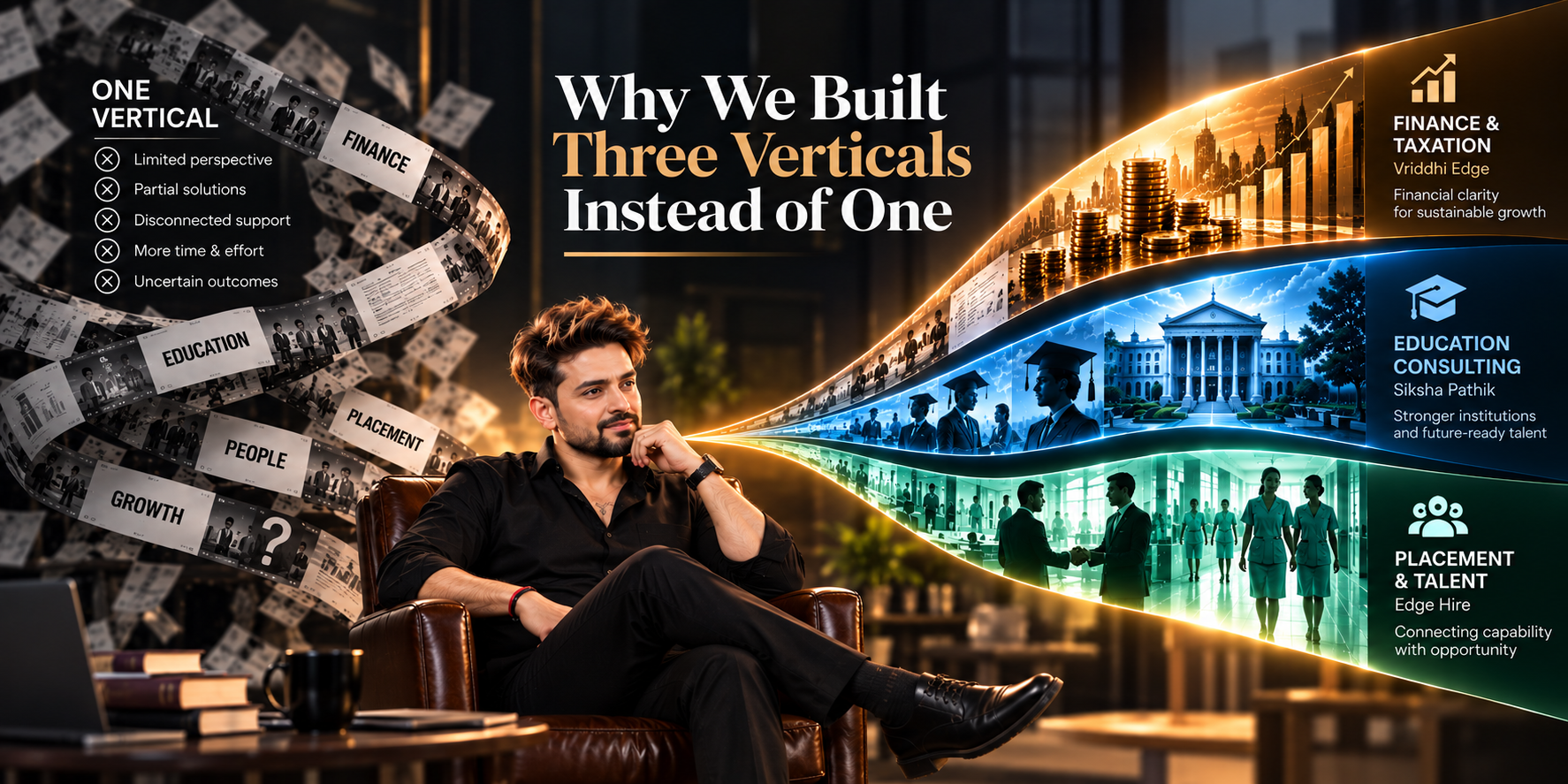
We built three distinct verticals under one brand — Finance & Taxation, Education Consulting, and Placement & Talent.
That decision was not made to make the organisation look broader. It came from a simple observation about how real problems actually appear.
They rarely arrive one department at a time.
A business does not always experience a finance problem separately from a people problem. An educational institution does not experience education separately from employability. And a candidate's career journey does not begin at the moment they apply for a job.
The connections already exist.
We simply chose to build around them.
The Problem With a Single Lane
Specialisation creates depth. But depth alone does not always create a complete solution.
A nursing institution facing a placement shortfall may also need to strengthen its financial structure. A growing business may need financial guidance while simultaneously dealing with workforce planning. A student may need more than an educational qualification; they may also need a realistic pathway from learning to employment.
From the inside, these may look like separate problems.
From the client's perspective, they are often part of the same journey.
That is where a single-domain model can create an unnecessary boundary. The client solves one problem, reaches the edge of the consultant's expertise, and then has to begin another relationship somewhere else.
We wanted to build something different.
Not a company that claims to do everything.
A company that develops genuine depth in carefully chosen areas where different problems naturally intersect.
Why Finance, Education, and Placement?
The three verticals were not selected because they happen to be commercially different. They were selected because they represent three important parts of a broader ecosystem: financial foundation, capability development, and opportunity.
- Finance & Taxation — Vriddhi Edge: The foundational layer. Individuals and organisations need sound financial and taxation thinking to make informed decisions, manage obligations and build sustainable growth.
- Education Consulting — Siksha Pathik: The capability layer. Education is not simply about operating an institution or delivering a curriculum. It is about building systems that help institutions, students and professionals move from learning toward meaningful outcomes, with particular attention to the realities of nursing and allied education.
- Placement & Talent — Edge Hire: The opportunity layer. Education creates capability, but capability creates greater value when it connects with the right opportunity. Edge Hire is designed to strengthen the connection between trained candidates and the institutions and organisations that need them.
Individually, each vertical has its own discipline.
Together, they reveal something more interesting.
Finance creates the foundation. Education develops capability. Placement connects capability with opportunity.
Three Verticals. One Underlying Logic.
It would be easy to look at the three verticals and see three separate businesses sharing a common identity.
That is not how we see them.
They are distinct by expertise, but connected by purpose.
A business needs financial clarity to make better decisions. An educational institution needs strong systems to develop people effectively. A trained candidate needs a meaningful pathway into the workforce.
The relationship between these areas is not artificial.
It already exists in the real world.
Our structure simply reflects that reality.
Why We Did Not Launch Everything at Once
There was another deliberate decision behind the model: we did not try to build all three verticals simultaneously.
Vriddhi Edge came first.
Siksha Pathik followed in 2024.
Edge Hire followed in 2026.
That sequence matters.
Building three verticals at the same time may have created a larger organisation faster, but speed was not the objective.
We wanted each vertical to develop its own identity, expertise and operating understanding before becoming part of a larger ecosystem.
That meant accepting a slower path to breadth.
We considered that a worthwhile trade-off.
Depth first. Connection second. Scale after that.
The Trade-Off We Accepted
There is an obvious cost to this model.
Building three verticals sequentially means accepting that the organisation will not have the same immediate depth across every area that a highly specialised single-domain firm might achieve.
We accepted that deliberately.
Because our objective was never to be the largest name in one narrow category simply by choosing the narrowest category.
Our objective was to build expertise where we saw meaningful connections — and to develop that expertise properly rather than prematurely combining everything under one label.
That distinction matters.
Three verticals do not automatically create an integrated business.
Integration has to be earned through capability, process and trust.
What This Structure Enables
The value of the model becomes clearer when viewed from the client's journey rather than from our organisational chart.
A nursing education institution can encounter an education challenge and later require a stronger pathway toward placement. A growing organisation may require financial guidance while also confronting workforce requirements. A candidate may move from education into employment, while the institutions involved need to think about both sides of that transition.
These are not theoretical connections.
They are points at which one challenge naturally creates another.
Our three-vertical structure allows those relationships to exist under one broader ecosystem rather than forcing every new requirement to begin with an entirely new relationship.
One Brand Does Not Mean One Skill Set
This distinction is important.
We are not trying to make finance professionals into education consultants, or education specialists into recruitment consultants.
Each vertical requires its own knowledge, discipline and way of working.
That is precisely why they remain separate verticals.
The strength comes from keeping the expertise distinct while allowing the thinking to connect.
Separate expertise. Shared direction.
The Principle Behind the Structure
We did not build three verticals because three sounded more impressive than one.
We built them because the problems we wanted to work on were already connected.
Finance influences whether an individual or organisation can sustain and grow. Education influences whether people and institutions can develop capability. Placement influences whether that capability ultimately meets opportunity.
Seen separately, these are three disciplines.
Seen through the journey of a client, institution or candidate, they can become three points of the same ecosystem.
That is the principle behind Roy Infinity Edge.
We do not believe every problem belongs to one consultant. We believe the right expertise should meet the problem at the point where it actually exists.
Why Three Instead of One?
Because one vertical would have been simpler.
It would have been easier to explain.
Easier to organise.
Easier to position.
But simplicity of structure is not always simplicity for the client.
Sometimes the better structure is the one that reflects the complexity of the real world.
That is why Roy Infinity Edge was built with three verticals.
Not to become everything to everyone.
Not to blur the boundaries between different professions.
And not simply to offer more services.
We built three verticals to develop depth where it matters, create connections where they are useful, and give clients a broader path to solving problems that do not naturally fit inside a single box.
Three Vertical. One Edge.
Vriddhi Edge, Siksha Pathik and Edge Hire operate in different domains.
But they share one underlying belief: meaningful solutions often emerge when expertise is not isolated from the wider problem.
That is the reason behind the structure.
Three verticals.
Different expertise.
One connected approach.
Roy Infinity Edge was not built to choose between specialisation and connection. We chose to build specialised verticals that know when—and how—to connect.