A credit card can make a purchase feel remarkably simple.
Tap. Swipe. Enter a PIN. Done.
The money may not leave your bank account immediately, and that small delay can change the way a purchase feels.
A ₹5,000 purchase can feel very different when ₹5,000 leaves your bank account today compared with when the same purchase appears on a credit-card statement later.
The transaction is the same.
The financial experience is not.
That difference matters even more today, as credit increasingly becomes part of India's everyday digital-payment environment.
In July 2026, credit-card payments in India reached about ₹2.08 lakh crore, while the number of credit cards in circulation stood at about 12.29 crore. Credit-card transactions also crossed 600 million that month.
At the same time, RuPay credit cards can be linked to UPI and used at eligible merchant QR codes. This means a credit transaction can increasingly look and feel like an ordinary digital payment.
That creates a question worth asking:
When borrowing becomes as easy as paying, do we still feel that we are borrowing?
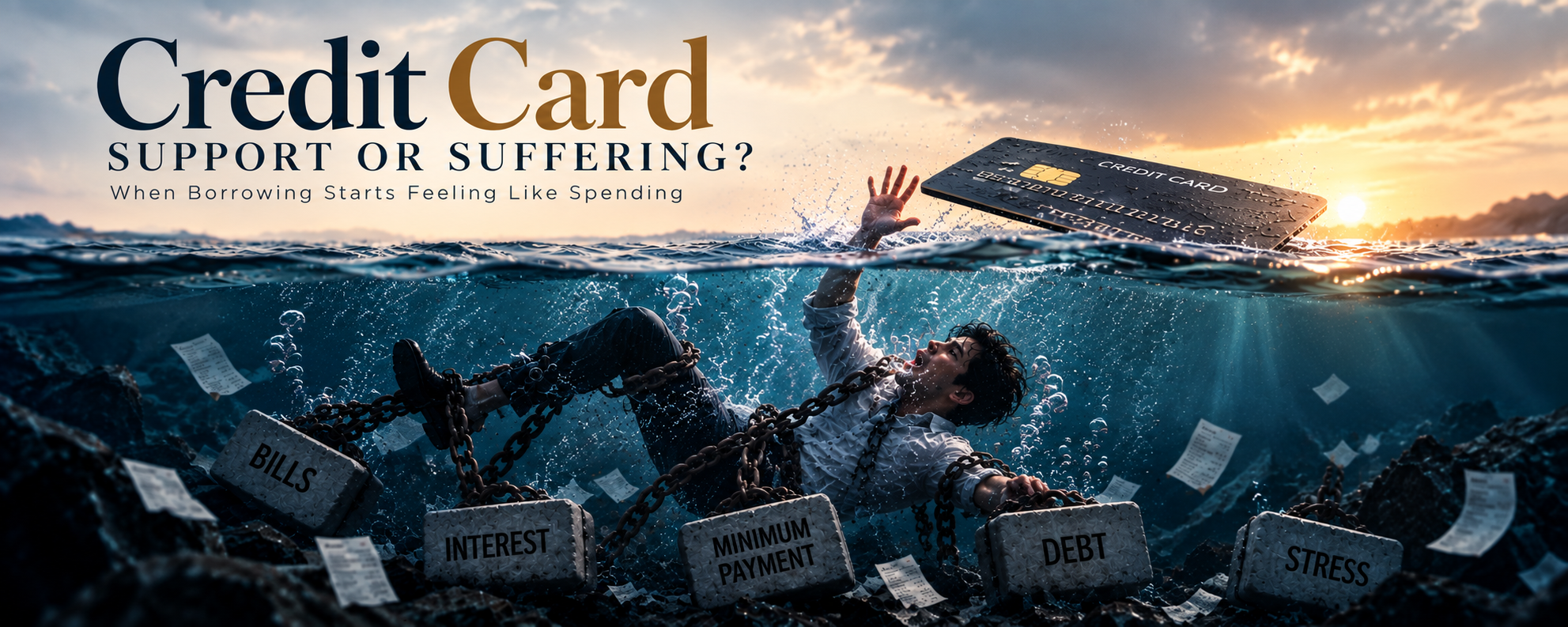
This is where a credit card can move from financial support to financial suffering—not because the card itself is inherently harmful, but because the psychological distance between spending and repayment can become very small.
A Credit Card Does Not Give You More Income
This is the first distinction every cardholder should understand.
A credit limit is not additional salary.
If a bank gives you a ₹1,00,000 credit limit, your monthly income has not increased by ₹1,00,000.
You have been given access to borrowed purchasing power.
Used responsibly, that purchasing power can be useful. But it remains an obligation that has to be repaid under the card's terms.
The danger begins when the credit limit starts being mentally treated as part of the person's available income.
Credit capacity is not earning capacity.
The Swipe Hides the Second Half of the Purchase
Every credit-card purchase has two moments.
The first is the moment of spending.
The second is the moment of repayment.
The first is immediate.
The second may arrive weeks later, after the excitement of the purchase has disappeared.
This separation can be useful when the cardholder already has the financial capacity to clear the bill. But it can also encourage spending decisions that might have felt different if the money had to leave the bank account immediately.
A credit card separates the moment of purchasing from the moment of paying.
That separation is one of the most important psychological features of modern consumer credit.
India's Credit Card Story Is Changing
Credit cards were once primarily associated with physical card payments, online purchases and larger discretionary expenses.
The payment environment is now more interconnected.
RuPay credit cards can be linked to UPI and used for eligible merchant payments by scanning a UPI QR code.
This creates an interesting change in the experience of credit.
When a person taps a physical credit card, they know they are using a credit card.
When an eligible RuPay credit card is selected inside a familiar UPI payment flow, the experience can feel much closer to ordinary digital spending.
The underlying source of funds has not changed.
The experience has.
And that is precisely why financial awareness matters.
The Credit Distance
Consider this idea: credit distance.
Credit distance is the psychological gap between making a purchase and feeling its financial consequence.
When you pay with cash, the distance is almost zero.
You hand over the money and immediately see that you have less of it.
With a debit transaction, the effect is similarly immediate.
With credit, the purchase can happen now while repayment happens later.
And when credit is integrated into familiar digital payment behaviour, the borrowing aspect can become less noticeable.
This does not make credit inherently dangerous.
It simply means that the easier borrowing becomes to experience as ordinary spending, the more important deliberate financial awareness becomes.
The After-Purchase Test
Most people judge a purchase before making it.
There is another way to judge it.
Judge it after making it.
This is the After-Purchase Test.
Before using credit for a discretionary purchase, ask:
- Can I repay the amount without disturbing essential expenses?
- Will paying this bill reduce my ability to handle an unexpected expense?
- Am I using the card because it is convenient, or because I cannot currently afford the purchase?
- Would I still make this purchase if the amount left my bank account today?
- Am I already carrying a balance from previous months?
The card can approve a transaction within seconds.
Your financial system has to absorb its consequences for much longer.
The Small-Purchase Problem
Credit-card discussions often focus on dramatic purchases.
A ₹1 lakh phone.
A ₹3 lakh holiday.
A large electronic purchase.
But financial pressure does not always arrive through one spectacular transaction.
It can arrive through dozens of ordinary ones.
₹499.
₹799.
₹1,299.
₹2,499.
₹699.
₹1,899.
Individually, none may appear alarming.
Together, they become a monthly financial commitment.
The lesson is not that small transactions are bad.
The lesson is that small does not mean insignificant when repeated often enough.
When a Credit Card Is Genuine Financial Support
A credit card can be a useful financial tool.
It can provide payment convenience, protection, transaction records, potential rewards and temporary flexibility when the cardholder has the underlying financial capacity to meet the obligation.
The important distinction is simple:
Using credit because you can comfortably repay it is different from using credit because you cannot currently afford the purchase.
In the first situation, the card primarily changes the method of payment.
In the second, it can change the affordability of the purchase itself.
That difference is more important than whether the card is premium, basic, metal or digital.
When Convenience Becomes Dependence
Credit dependence rarely begins with a dramatic financial decision.
It can begin quietly.
An unexpected bill goes on the card.
Then an online purchase.
Then dining.
Then travel.
Then another expense.
Eventually, the next salary arrives with part of it already mentally allocated to previous spending.
The cycle begins to look like this:
Income → Spending → Credit → Repayment → Less Available Income → More Credit
The card has stopped being a convenient payment mechanism.
It has become part of the person's cash-flow structure.
That is the point where support can begin becoming suffering.
The Minimum Payment Is Not a Measure of Affordability
The phrase “minimum amount due” can create a misleading sense of comfort.
Being able to make the minimum payment does not mean that the underlying purchase was affordable.
The Reserve Bank of India requires card issuers to warn customers that repeatedly paying only the minimum can stretch repayment over months or years and result in compounded interest. The interest-free period can also be suspended when a previous balance remains outstanding.
That makes the relevant question different.
Instead of asking:
“Can I pay the minimum?”
ask:
“What will this purchase ultimately cost me, and how long will it occupy my future income?”
The first question concerns immediate payment.
The second concerns financial consequence.
The Rewards Trap: When Saving Becomes a Reason to Spend
Rewards, cashback and discounts can be legitimate benefits of responsible credit-card use.
But there is a psychological trap hidden inside the language of rewards.
A discount can make spending feel like saving.
Cashback can make spending feel productive.
Points can make spending feel like progress.
But if the purchase would not have happened without the reward, the reward has not necessarily created a financial gain.
Spending ₹10,000 to receive a small benefit is still spending ₹10,000.
The best reward is not receiving points for a purchase you never needed to make.
Credit Can Quietly Finance Lifestyle Inflation
Lifestyle inflation is usually associated with rising salaries.
Credit can accelerate the same process.
A person may begin living at a level that their current income cannot comfortably support because credit temporarily closes the gap.
Once that lifestyle becomes normal, reducing it can feel like going backwards.
The result can be a particularly uncomfortable financial situation:
Income rises, but financial freedom does not rise at the same pace.
The person earns more, yet becomes increasingly dependent on continuing to earn more.
The Future You Is the One Who Pays
Every credit purchase creates a relationship between two versions of the same person.
The present version wants the purchase.
The future version has to fund it.
That future version may have different priorities.
There may be an unexpected expense, a career transition, a family responsibility, an investment opportunity or simply a month in which income is lower than expected.
Future income is not guaranteed to remain as comfortable as today's income.
Every credit purchase is a decision that asks your future income to cooperate with your present desire.
The “Would I Buy It With Cash?” Question
One simple awareness test can expose the difference between convenience and dependence.
Before making a discretionary purchase with a credit card, ask:
“If this amount had to leave my bank account today, would I still buy it?”
If the answer is yes, the card may simply be changing the payment mechanism.
If the answer is no, the card may be changing the affordability of the decision.
That distinction deserves attention.
The Real Warning Sign Is Not Having a Credit Card
Credit-card ownership is not evidence of financial irresponsibility.
Nor is a high credit limit automatically a sign of financial strength.
The more meaningful question is what role the card plays in the person's financial life.
Warning signs can include:
- Regularly carrying balances from one month to another.
- Using credit to cover recurring essential expenses because available income is insufficient.
- Depending on the next salary to clear ordinary previous spending.
- Increasing spending simply because the credit limit increased.
- Feeling significant anxiety when the statement arrives.
- Repeatedly paying only the minimum amount due.
- Accumulating balances faster than they can realistically be repaid.
These are not moral failures.
They are financial signals.
And signals are most useful when recognised early.
Support or Suffering? Follow the Direction of the Money
There is a simple way to understand the difference.
In healthier credit use, income remains the foundation and credit remains a payment tool.
In problematic credit use, credit begins filling a recurring gap between income and spending.
The direction has changed.
Credit is no longer supporting the person's financial system.
The person's future income is increasingly being used to support past credit spending.
That reversal is the real warning sign.
How to Get Out When Credit Has Already Become a Problem
Recognising the problem is only the first step. The more important question is what to do when the credit-card balance has already started controlling your monthly cash flow.
The answer is not to panic—and it is not to keep borrowing simply because the next payment feels difficult.
Start by making the situation visible.
1. Stop Treating the Credit Limit as Available Money
If credit has become a regular source of spending money, the first step is to stop adding new discretionary purchases to the problem.
This does not mean every credit-card transaction must immediately stop in every circumstance. It means new borrowing should no longer be the default solution to an existing repayment problem.
Do not try to escape a debt cycle by creating another cycle of debt.
2. Calculate the Real Outstanding Amount
Write down every credit-card balance, including the outstanding amount, applicable interest or charges, payment due date and any instalment obligations.
Do not rely on memory.
A problem that exists only as a vague feeling can feel larger than it is—or smaller than it is. A written number gives you something concrete to solve.
3. Protect Essential Expenses First
Debt repayment matters, but basic living expenses cannot simply disappear.
Separate essential expenses such as food, housing, utilities, transportation and necessary family commitments from discretionary spending.
The objective is to create a repayment plan that is aggressive enough to reduce the balance but realistic enough to survive the month without immediately requiring more borrowing.
4. Stop Looking Only at the Minimum Due
The minimum amount due can keep an account from becoming overdue, but it should not automatically become the repayment strategy.
If you have the capacity to pay more, increasing the amount directed toward the outstanding balance can reduce the time that debt remains in your financial life.
The exact cost and repayment period depend on the card's terms, interest rate, fees and outstanding balance, so check the statement and issuer's disclosures rather than assuming a generic calculation applies.
5. Attack the Most Expensive Debt
If you have multiple credit-card balances or other forms of high-cost debt, compare their interest rates and charges.
After meeting required payments, directing additional repayment toward the highest-cost debt can be an efficient way to reduce the financial drag created by interest.
The important point is to have a deliberate repayment order rather than simply paying whichever bill feels most urgent that month.
6. Create a Temporary Spending Reset
Getting out of credit-card dependence may require a period of deliberately reducing discretionary spending.
That could mean postponing non-essential purchases, reducing subscriptions, limiting impulse purchases or temporarily changing how you spend on entertainment and shopping.
This is not about permanently living with restrictions.
It is about creating enough breathing room for your income to catch up with your past spending.
7. Do Not Hide From the Statement
Avoiding the credit-card statement does not reduce the balance.
Review it regularly. Identify recurring charges, unnecessary purchases, fees and spending categories that contributed to the balance.
The goal is not simply to repay the existing debt.
The goal is to understand what created it so that the same pattern does not rebuild the balance later.
8. Ask for Help Before the Situation Becomes Unmanageable
If the balance has become impossible to manage from available income, do not rely on increasingly expensive borrowing to keep making payments.
Contact the card issuer and understand the options available under the account's terms. Where necessary, seek qualified financial advice and evaluate restructuring or other legitimate repayment options carefully.
Any new repayment arrangement should be judged by its total cost, repayment period and effect on future cash flow—not merely by whether it lowers the next month's payment.
9. Build a Small Financial Buffer After the Debt Starts Falling
Debt repayment alone does not solve the underlying vulnerability if every unexpected expense immediately goes back onto a credit card.
Once repayment is becoming manageable, begin building an emergency buffer appropriate to your circumstances.
The objective is simple: the next unexpected expense should not automatically become the next credit-card balance.
10. Change the System, Not Just the Balance
A person can repay a ₹50,000 credit-card balance and recreate the same ₹50,000 problem six months later.
That is why recovery is not complete when the statement reaches zero.
Recovery is complete when the behaviour and cash-flow system that created the debt have also changed.
The goal is not merely to become debt-free once. It is to become less dependent on debt to maintain your life.
What Responsible Credit Actually Looks Like
Responsible credit use does not mean being afraid of every credit-card transaction.
It means understanding the relationship between spending, repayment and cash flow.
A responsible cardholder should know:
- What they have spent.
- When the payment is due.
- What amount needs to be paid.
- What happens if a balance is carried forward.
- What interest and charges apply under the card's terms.
- Whether the purchase fits comfortably within their financial capacity.
The objective is not simply to avoid debt.
It is to prevent credit from silently becoming a requirement for maintaining everyday life.
The Credit Card Should Expand Convenience—Not Replace Financial Capacity
The healthiest relationship with a credit card is one in which the card remains optional.
You can use it, but you do not depend on it.
You can pay the bill without sacrificing essential expenses.
You can see exactly what you have spent.
You understand the consequences of carrying a balance.
And your lifestyle does not require continuous borrowing to remain intact.
That is financial control.
The Three Questions Before the Swipe
Before making the next discretionary purchase, pause for a few seconds and ask:
- Can I afford this without depending on future income?
- Am I using credit for convenience or to create affordability?
- What will this purchase do to my next month's financial freedom?
The third question may be the most important.
Affordability is not only about whether you can complete the transaction.
It is also about what remains possible after you make it.
Credit Is a Tool. Dependence Is the Risk.
A credit card can provide genuine value.
It can simplify payments, provide flexibility and offer legitimate benefits when used within a person's financial capacity.
But the same mechanism can become harmful when borrowed purchasing power begins to substitute for income, savings or financial planning.
The card itself is not the whole story.
The relationship between the card, the person's income, spending behaviour, repayment ability and future cash flow is what matters.
Beyond the Swipe
The most important thing about a credit card is not the card in your wallet.
It is the financial behaviour that the card makes possible.
If it helps you organise payments without changing your underlying financial stability, it may be a useful tool.
If it repeatedly allows you to spend money you do not currently have and depend on tomorrow's income to pay for yesterday's decisions, it can become a source of financial stress.
That is why the right question is not simply:
“Is a credit card good or bad?”
The better question is:
“When I use credit today, am I creating convenience—or transferring today's lifestyle into tomorrow's financial burden?”
A credit card can be support.
It can also become suffering.
The difference is not in the plastic. It is in what happens after the swipe.