A nursing student can know the steps of a procedure, explain the rationale behind it, and even perform it successfully in a controlled learning environment. Yet when the same procedure has to be performed on a real patient, hesitation can suddenly appear.
The hands slow down. The student double-checks every step. A simple decision feels more significant. There may be a fear of making a mistake, causing discomfort, or being judged by a clinical supervisor.
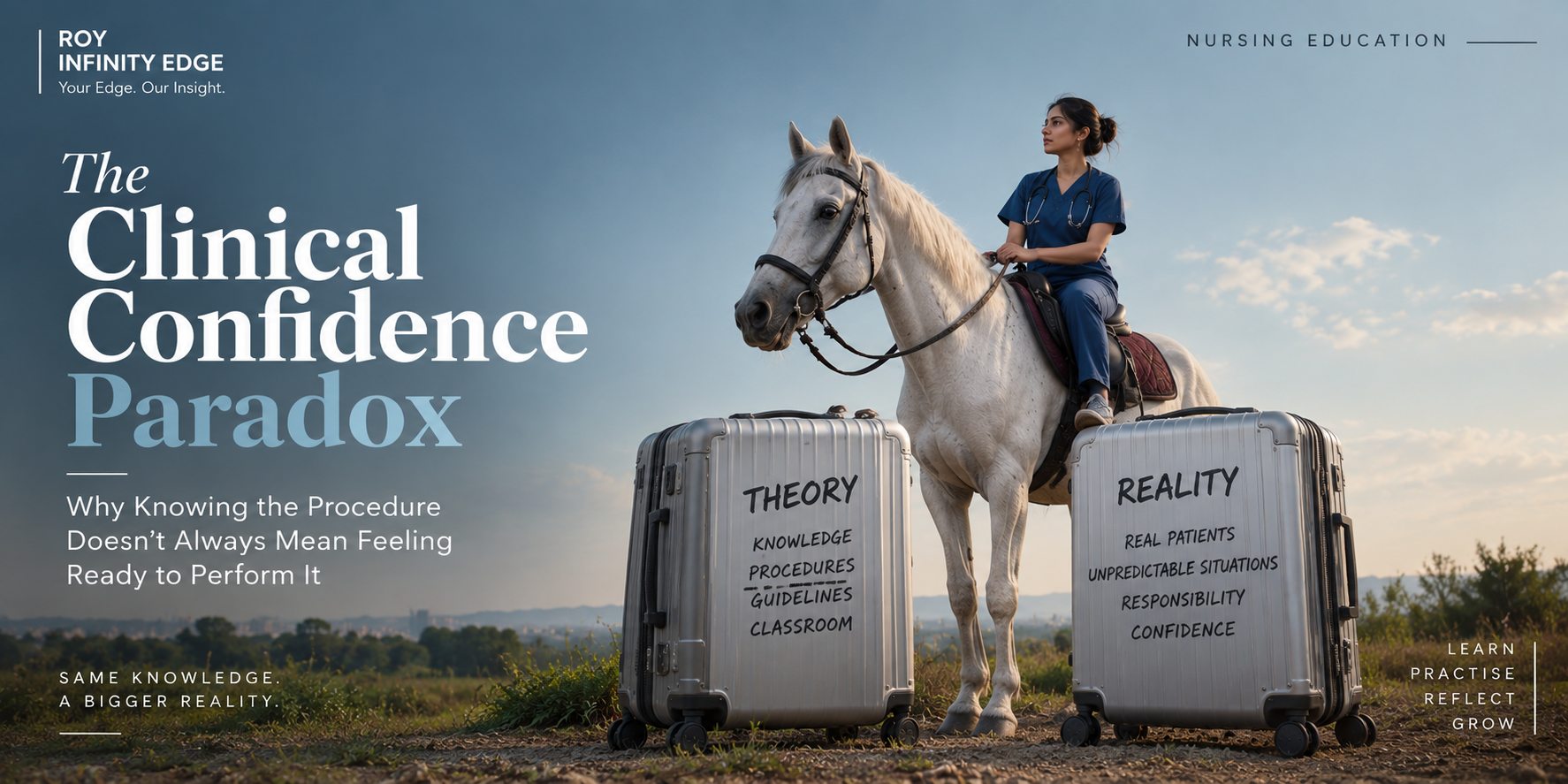
This is the clinical confidence paradox: knowing how to perform a procedure does not automatically mean feeling ready to perform it.
Knowledge and Readiness Are Not the Same Thing
Nursing education naturally places significant emphasis on knowledge. Students study anatomy, physiology, pharmacology, procedures, precautions, documentation and clinical protocols.
That knowledge is essential. But clinical practice introduces something that a textbook cannot fully reproduce: uncertainty.
A textbook may present a procedure in a logical sequence. A real patient may be anxious, uncomfortable, unable to communicate clearly, or physically different from the example the student has practised with.
The student therefore has to do more than remember the procedure. They must observe the patient, communicate appropriately, adapt to the situation, maintain safety and decide what to do when reality does not perfectly match the expected sequence.
Clinical competence is not simply remembering the right steps. It is knowing how to apply those steps when the situation becomes real.
Why Students Hesitate Even When They Know the Procedure
Hesitation is not necessarily evidence of poor preparation. In many situations, it reflects the transition from academic knowledge to professional responsibility.
- Fear of making an error: A student understands that a real patient is not a practice model.
- Performance pressure: Being observed by a clinical instructor or senior nurse can make familiar tasks feel more difficult.
- Limited exposure: Knowing a procedure theoretically is different from encountering different patients repeatedly.
- Unpredictability: Real clinical situations rarely follow textbook examples perfectly.
- Communication demands: The student must explain the procedure, obtain cooperation and respond to the patient's concerns.
- Responsibility: The student begins to understand that clinical decisions have consequences.
These factors can create a gap between “I know how to do this” and “I am ready to do this safely.”
The Four Stages Behind Clinical Confidence
Clinical confidence can be understood as a progression rather than a switch that simply turns on after a student learns a procedure.
Knowledge → Skill → Confidence → Clinical Judgement
Knowledge provides the foundation. The student understands what should be done and why.
Skill develops when knowledge is translated into action through demonstration, simulation and supervised practice.
Confidence grows when the student repeatedly performs the skill, receives constructive feedback and learns that they can manage the task safely.
Clinical judgement develops further when the student learns to recognise that the correct action can depend on the patient's condition and the context.
The important point is that these stages are connected but not identical. A student may possess strong knowledge while still developing practical confidence.
Why Repetition Matters—but Repetition Alone Is Not Enough
Repeated clinical exposure is one of the strongest ways to develop familiarity. However, simply performing the same procedure repeatedly does not guarantee meaningful learning.
Effective repetition should include observation, supervised performance, feedback and reflection.
After performing a procedure, a student should be encouraged to consider questions such as:
- What did I do well?
- Where did I hesitate?
- What did I notice about the patient?
- What would I do differently next time?
- Did I understand why I performed each step?
This turns repetition into deliberate learning rather than mechanical repetition.
Simulation Can Create a Safer Bridge to Reality
Simulation has an important role in closing the gap between classroom knowledge and clinical practice.
A simulation environment allows students to practise procedures, communication and decision-making before they encounter similar situations with real patients.
More importantly, simulation can introduce controlled uncertainty. A scenario can change unexpectedly, requiring the student to pause, reassess and respond.
This matters because clinical confidence should not be built around the belief that everything will go according to plan. It should be built around the ability to respond appropriately when something does not.
Confidence Should Not Become Overconfidence
There is another side to the clinical confidence paradox.
The objective of nursing education is not to make students feel confident at all times. It is to help them become appropriately confident about what they know, aware of what they do not know and willing to seek assistance when necessary.
A student who confidently performs a procedure without recognising their limitations may present a greater safety concern than a student who pauses and asks for guidance.
Therefore, healthy clinical confidence includes knowing when to stop, verify and escalate.
The goal is not fearless nursing. The goal is safe, informed and appropriately confident nursing.
The Role of Clinical Educators
Clinical educators have a major influence on how students develop confidence.
Feedback that focuses only on mistakes can make students increasingly afraid of performing procedures. On the other hand, feedback that ignores errors does not prepare students for professional responsibility.
A stronger approach is specific, constructive and reflective.
Instead of simply saying that a student performed a procedure incorrectly, an educator can identify what happened, explain why it matters, demonstrate the correct approach and provide an opportunity to try again.
This creates a learning environment where mistakes become opportunities for correction rather than reasons to avoid participation.
What Nursing Education Should Ultimately Build
The strongest nursing education does not produce students who merely memorise procedures.
It develops students who can connect knowledge with action, recognise patient needs, communicate clearly, adapt when circumstances change and understand the limits of their own competence.
That means clinical education should progressively move students through different levels of responsibility:
- Understanding the procedure
- Observing the procedure
- Practising the procedure
- Performing the procedure under supervision
- Reflecting on performance
- Applying judgement in changing situations
Each stage contributes something different to professional development.
The Real Meaning of Clinical Confidence
Clinical confidence is often misunderstood as the absence of hesitation.
In reality, a thoughtful pause can sometimes demonstrate professional awareness. The important question is not whether a student hesitates, but why they hesitate and what they do next.
Do they panic, guess and continue?
Or do they assess the situation, verify the information, communicate appropriately and seek assistance when required?
That distinction matters.
A nursing student does not become clinically ready simply because they can reproduce the steps of a procedure from memory. Readiness develops when knowledge, practical skill, repeated exposure, communication, reflection and clinical judgement begin working together.
Beyond Knowing: Becoming Ready
The journey from nursing student to competent professional is not a straight line from textbook knowledge to clinical confidence.
There is a space in between—a space where students practise, hesitate, make mistakes, receive feedback, ask questions and gradually learn how to translate knowledge into safe action.
That space should not be treated as a weakness in nursing education. It is an essential part of learning.
The real objective is therefore not simply to make students confident.
It is to help them become competent enough to act, thoughtful enough to pause, and responsible enough to know when they need help.
That is what turns procedural knowledge into clinical readiness.