When people think about nursing, they often picture the visible moments of patient care: checking vital signs, administering medication, assisting patients and providing comfort.
But some of the most important nursing skills happen where patients may never see them.
Behind an effective patient interaction are observations, decisions, documentation, communication and coordination. These activities may not always be visible at the bedside, but they can have a direct influence on patient safety, continuity of care and the quality of nursing practice.
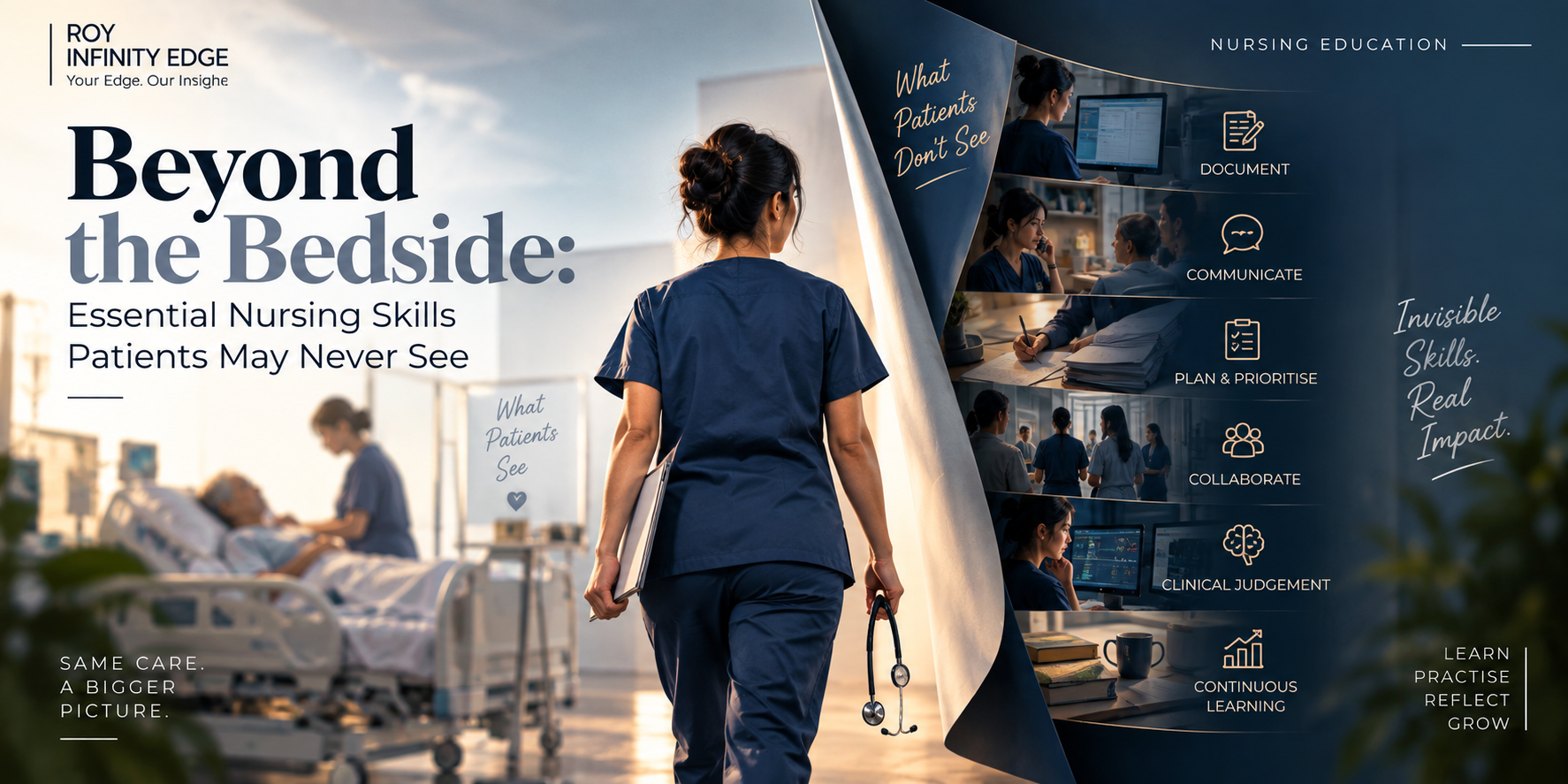
This is the idea behind “Beyond the Bedside”: understanding nursing not only through what patients see, but also through the professional work that happens around every patient encounter.
Nursing Is More Than What Patients See
A patient may remember the nurse who provided reassurance, administered medication or helped them move safely. These visible interactions are an important part of nursing.
However, effective patient care also depends on activities that may happen before or after that interaction.
A nurse may have already reviewed the patient's condition, identified a change in their observations, checked relevant information, communicated with another healthcare professional and documented important findings.
None of these activities necessarily looks dramatic. Yet together, they form an essential part of professional nursing practice.
Some of the most important nursing work happens outside the patient's field of view.
Clinical Observation: Seeing What Others May Miss
One of the fundamental nursing skills is observation.
Nurses spend significant time monitoring patients and recognising changes in their condition. This involves more than recording numbers such as temperature, pulse, blood pressure or oxygen saturation.
Clinical observation can also involve noticing changes in behaviour, appearance, communication, mobility, breathing, comfort or responsiveness.
A small change may not appear significant in isolation. But when considered alongside the patient's history and other clinical information, it may become important.
This ability to observe, compare and communicate relevant changes is an important part of clinical nursing practice.
Documentation: The Care That Continues on Paper
Documentation is another nursing responsibility that patients may rarely see.
Accurate clinical documentation creates a record of relevant observations, interventions, responses and communication. It also supports continuity when different healthcare professionals participate in a patient's care.
Good documentation is not simply administrative work. It is part of professional communication.
A clear record can help another healthcare professional understand what has happened, what has changed and what may require further attention.
For nursing students, learning to document accurately is therefore part of developing professional competence—not merely completing paperwork.
Communication Happens Beyond the Conversation With the Patient
Nursing communication extends far beyond speaking with patients.
Nurses communicate with doctors, other nurses, allied healthcare professionals, patients' families and members of the wider care team.
Effective communication requires information to be clear, relevant and appropriately prioritised.
A nurse may need to communicate a change in a patient's condition, clarify an instruction, provide a handover or raise a concern.
These interactions may take only a few moments, but the quality of that communication can influence how effectively care is coordinated.
Prioritisation: Deciding What Needs Attention First
Healthcare environments rarely present one task at a time.
A nurse may have several patients, multiple responsibilities and changing clinical demands. The ability to determine what requires immediate attention and what can safely wait is therefore an important nursing competency.
Prioritisation is not simply about working quickly.
It requires the nurse to consider patient condition, risk, urgency, available information and the potential consequences of delaying an action.
For nursing students, developing this skill can be challenging because prioritisation often becomes clearer when theoretical knowledge is applied to real clinical situations.
Clinical Decision-Making Is Often Invisible
Patients may see a nurse perform an action without seeing the reasoning that led to it.
For example, a nurse may decide to reassess a patient, report a change, seek assistance or modify the sequence of tasks based on information gathered during care.
These decisions are part of clinical judgement.
Clinical decision-making requires nurses to connect patient information with professional knowledge, clinical standards and the specific circumstances of the situation.
This is one reason nursing education cannot rely entirely on memorisation. Students also need opportunities to develop reasoning and judgement.
Teamwork: Nursing Does Not Happen in Isolation
Modern healthcare is a team-based environment.
Nurses work alongside doctors, pharmacists, physiotherapists, technicians, healthcare assistants and other professionals. Effective patient care therefore depends partly on how well information and responsibilities move between members of the team.
A nurse may coordinate information, clarify responsibilities, communicate patient needs or support another member of the care team.
Patients may not see these interactions, but they contribute to continuity and coordination of care.
Time Management Is a Clinical Skill
Time management is sometimes treated as a general workplace skill. In nursing, however, it has a direct relationship with patient care.
Nurses must organise multiple responsibilities while remaining responsive to changes in patient needs.
Effective time management involves planning, prioritising, anticipating potential problems and adjusting when circumstances change.
For nursing students, developing this ability during clinical placements can be just as important as learning individual procedures.
The Difference Between Doing a Task and Understanding Its Purpose
A nursing student may successfully perform a procedure and still have more to learn.
Professional competence involves understanding why the procedure is being performed, what should be observed before and after it, what risks may exist and what action should be taken if the patient's condition changes.
This distinction separates procedural performance from broader clinical competence.
The goal of nursing education should therefore be to help students move from “I know how to do this” toward “I understand what I am seeing, why this matters and what I should do next.”
What Nursing Students Need Beyond Technical Skills
Technical nursing skills remain essential. Students must learn procedures correctly and safely.
But professional nursing education also needs to develop less visible competencies, including:
- Clinical observation
- Critical thinking
- Clinical judgement
- Patient communication
- Professional documentation
- Prioritisation
- Team collaboration
- Time management
- Problem-solving
- Recognition of changes in patient condition
These skills may not always appear as dramatic moments during clinical practice, but they influence how effectively a nurse responds to real situations.
Why Nursing Education Must Look Beyond the Procedure
Teaching a procedure is only one part of preparing a nursing student for professional practice.
Students also need to understand the context surrounding that procedure.
Why is it being performed?
What should be assessed before performing it?
What changes should be reported?
How should the patient be informed?
What should be documented?
When should assistance be requested?
These questions encourage students to connect technical skills with clinical reasoning and professional responsibility.
The Skills Patients May Never Notice
A patient may never know how carefully a nurse reviewed their information before entering the room.
They may not see the documentation completed after an interaction, the handover provided to another nurse, or the decision to escalate a concern.
They may not notice the prioritisation required to manage several competing responsibilities.
Yet these actions can be essential to safe and coordinated care.
Good nursing is not defined only by what happens at the bedside. It is also defined by the thinking, communication and responsibility behind it.
Beyond the Bedside: A Broader Definition of Nursing Competence
Nursing competence cannot be reduced to a list of procedures a student can perform.
A competent nurse must also be able to observe, interpret, communicate, prioritise, document, collaborate and make appropriate decisions within their scope of practice.
These capabilities develop gradually through education, supervised practice, clinical exposure, feedback and reflection.
For nursing students, recognising this broader definition of competence can change how they approach clinical learning.
Every patient interaction becomes an opportunity not only to practise a procedure, but also to improve observation, communication, reasoning and professional judgement.
The Real Work Behind Patient Care
The visible side of nursing is only part of the profession.
Behind every medication administration, patient assessment or bedside interaction may be a series of observations, decisions, communications and actions that patients never see.
These invisible competencies deserve attention because they help connect individual nursing tasks to the larger objective of safe, coordinated and patient-centred care.
For nursing education, the message is clear: teaching students what to do is important, but teaching them how to think, observe and respond is equally essential.
Because the strongest nursing practice does not stop at the bedside.
It begins with what the patient sees—and is strengthened by everything happening beyond it.